Si Thep is not one compact enclosure containing every landmark shown in its World Heritage photographs. Plan the ancient town and Khao Klang Nok as distinct parts of the visit, and treat Khao Thamorrat Cave as a separate excursion that requires its own access check. This distinction makes a bigger difference to your day than trying to memorize the names of every monument before you arrive.
Understand the three-part World Heritage property
UNESCO describes an ancient twin-town layout with inner and outer towns, the large Khao Klang Nok monument and Khao Thamorrat Cave as three component parts of the World Heritage property inscribed in 2023. They demonstrate Dvaravati-period religious and artistic traditions, including Buddhist and Hindu influences. The inscription does not mean that one visitor entrance, one shuttle or one easy walking circuit connects all three.
For a first visit, make the ancient town your introduction. Its urban layout helps place the surviving religious monuments in context before you see an isolated building outside it. A plan that goes straight to the largest outer monument can work for someone with a specific interest, but it is a different visit from understanding the old city as a settlement.

Inside the town: compare monuments carefully
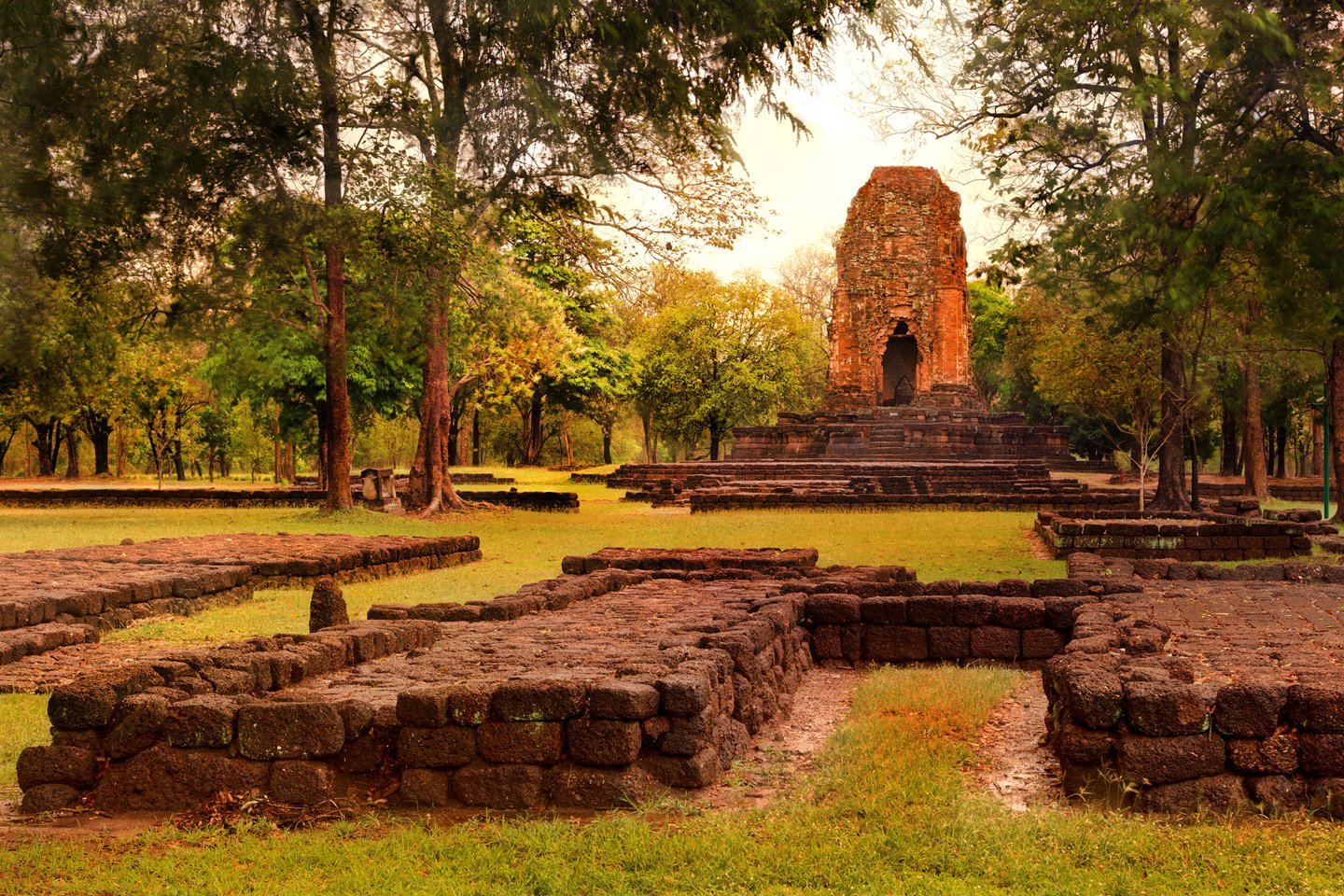
The department’s inventory locates Prang Song Phi Nong, Prang Si Thep and Khao Klang Nai within the inner-town area. Use the park map to choose a permitted circuit between them. They are not three names for one ruin: compare the towers with the large base at Khao Klang Nai, and give each information panel time before deciding what the structures represent.
At Khao Klang Nai, look for the surviving stucco decoration and supporting figures around the base from the permitted viewing positions. The department describes the monument as a large laterite religious structure with changes of use over time. The local name is associated with a belief about stored treasure or weapons, but that story is not the same as the archaeological interpretation of a Buddhist building. This is a useful place to distinguish a name, a tradition and physical evidence.
A short visit can concentrate on that contrast between the inner-town towers and Khao Klang Nai. Do not add a tightly timed list of every excavated feature if the intention is to understand what you are seeing. Conservation areas and barriers take precedence over a circuit copied from a travel photograph.

Khao Klang Nok needs a transfer decision
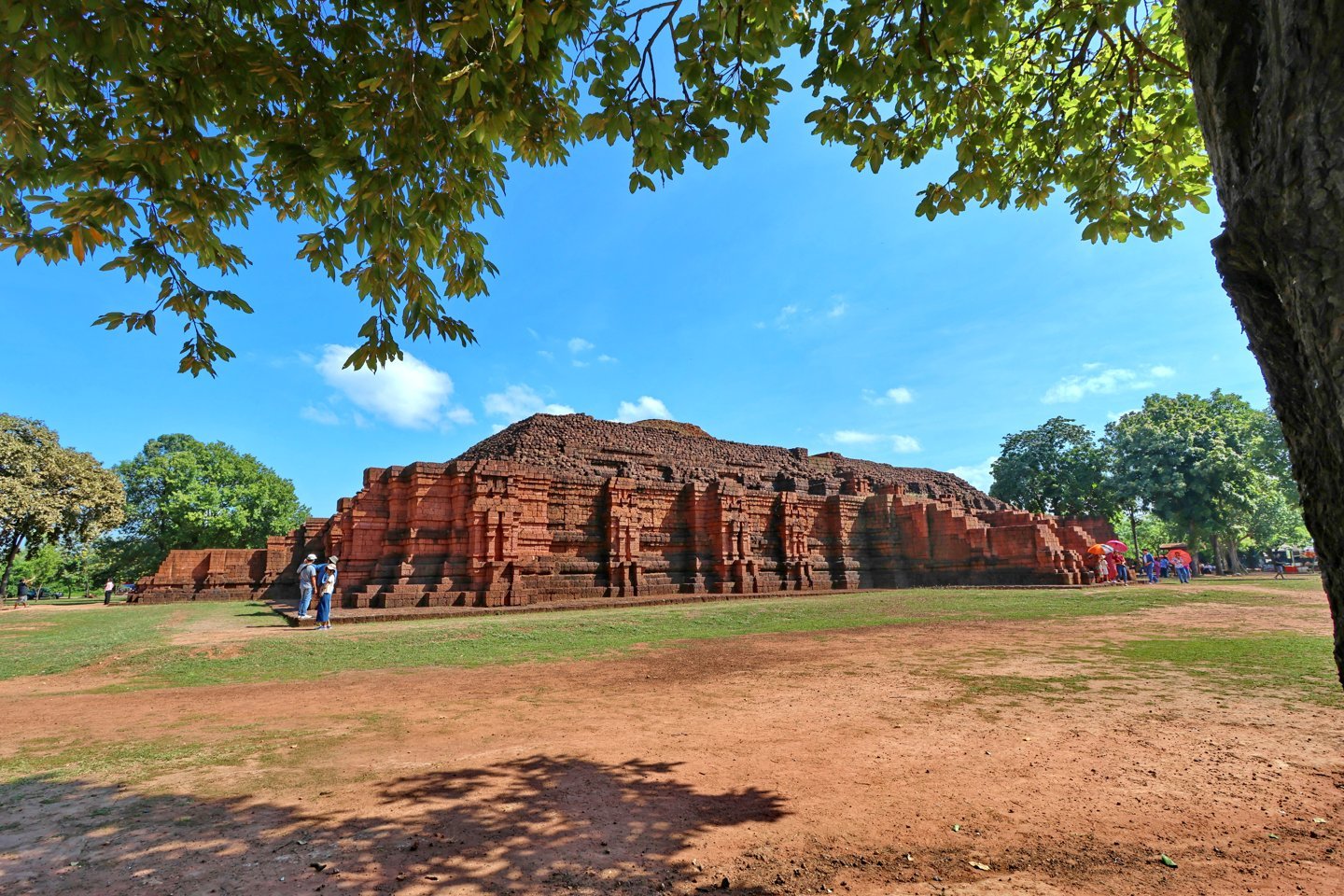
Khao Klang Nok is outside the ancient town to the north. The department places it approximately two kilometres from the city and describes a substantial square laterite monument with multiple levels. Its name is easy to confuse with Khao Klang Nai, but the two are separate structures. Tell a driver which one you mean, and check the destination name when choosing a map result.
For most first-time visitors, the useful pairing is the inner-town group followed by Khao Klang Nok. This is our suggested sequence, not an official timetable. Arrange the transfer and return before leaving the main visitor area. Do not assume the archaeological distance quoted by the department is a measured pedestrian route from the ticket office, or that a shuttle mentioned elsewhere is operating without a current confirmation.
The monument’s scale is worth viewing from ground level as well as from any permitted higher viewpoint. An older department description mentions a western stair access, but present barriers determine where you may actually go. Do not plan the visit around a promise that climbing will be allowed on your date.
Why the cave is not an automatic add-on
The department locates Khao Thamorrat Cave to the west of the ancient town, approximately 15 kilometres away, and describes religious carvings in a natural limestone cave. That makes it a different physical outing from the urban ruins. Its inclusion in the World Heritage property should not be mistaken for routine access on the same ticket and transport arrangement.
Before adding it, ask the park about the current route, local guidance, permission requirements and weather-related limitations. This guide has not verified a current cave-guide booking system, climbing time or access opening. If those details remain unresolved, keep the cave off the day’s fixed commitments and give the ancient town and Khao Klang Nok the time already available. This is a planning limit, not a statement that the cave is permanently closed.
Hours, tickets and realistic expectations
The department’s QR visitor page lists daily service from 08:30 to 16:30, including public holidays, with published admission of 20 baht for Thai visitors and 100 baht for foreign visitors. That page does not provide a clear recent tariff revision date. Use it as an online reference and confirm the current admission rate, component coverage and last entry before making a special journey.
No current shuttle departure schedule, rental vehicle fee or advance-booking requirement has been established in this guide. Ask at the visitor point which facilities are operating that day. The hours for the main park should not be assumed to authorize cave access or admission to every outlying structure, and a past free-admission announcement should not be treated as an ordinary-year-round entitlement.
Choose an overnight base for the actual drive
Compare accommodation around Si Thep and the wider Wichian Buri area by its actual road connection, rather than selecting a hotel merely because it is in Phetchabun Province. The province label can hide a substantial transfer. If using a hired driver, agree the departure and return points and whether the outer monument is included before the sightseeing day begins.
Our first-day recommendation is an unhurried ancient-town circuit, a break, then Khao Klang Nok if access and transport are confirmed. This is an editorial allocation of the day rather than a guarantee of fixed visit durations. Someone interested in inscriptions, sculpture or excavation displays may reasonably spend longer in the main visitor area and omit the cave altogether. Keeping that choice open produces a more useful visit than treating the World Heritage title as a requirement to reach every component in one day.
Sources & visit notes
- https://whc.unesco.org/en/list/1662/
- https://qrcode.finearts.go.th/index.php/th/historicalpark/srithep
- https://qrcode.finearts.go.th/index.php/th/historicalpark/srithep/srithep-05
- https://qrcode.finearts.go.th/index.php/th/historicalpark/srithep/srithep-02/item/265-srithep03-004
- https://qrcode.finearts.go.th/index.php/th/historicalpark/srithep/srithep-02/item/267-srithep03-006
- https://qrcode.finearts.go.th/index.php/th/historicalpark/srithep/srithep-02/item/269-srithep03-008