Sukhothai Historical Park is easiest to plan as several separate sightseeing areas, rather than one entrance followed by an uninterrupted walk. Start with the walled central town if this is your first visit. Add the northern monuments or western forest-monastery area only after deciding how you will travel between them. A photograph of Wat Mahathat does not show the scale of the wider archaeological landscape, and a ticket for one area should not be assumed to cover every monument.
Begin with the central town
Wat Mahathat is the most useful first stop because it gives you a reference point for comparing the other remains. The Fine Arts Department identifies its lotus-bud main chedi, surrounding subsidiary chedis and large standing Buddha images. Look at the relationship between the principal shrine and the surrounding platforms before moving to individual sculptures. This is a better introduction than trying to photograph every Buddha image without understanding the compound.
For a compact first circuit, our suggested order is Wat Mahathat, Wat Si Sawai, then the water-associated monuments around Wat Traphang Ngoen and Wat Sa Si. This is an editorial selection, not a marked official tour or a promise about travel time. Use the entrance map to choose the actual paths and return point. It leaves room to read signs and notice changes in building form instead of making the day a checklist.
Wat Si Sawai is particularly useful for comparison: its three prangs have a different appearance from the lotus-bud chedi at Wat Mahathat. The department describes evidence of an earlier Hindu sanctuary and later Buddhist use. You do not need specialist architectural knowledge to make that contrast worthwhile; read the site explanation, then look again at the towers and the later buildings in front.
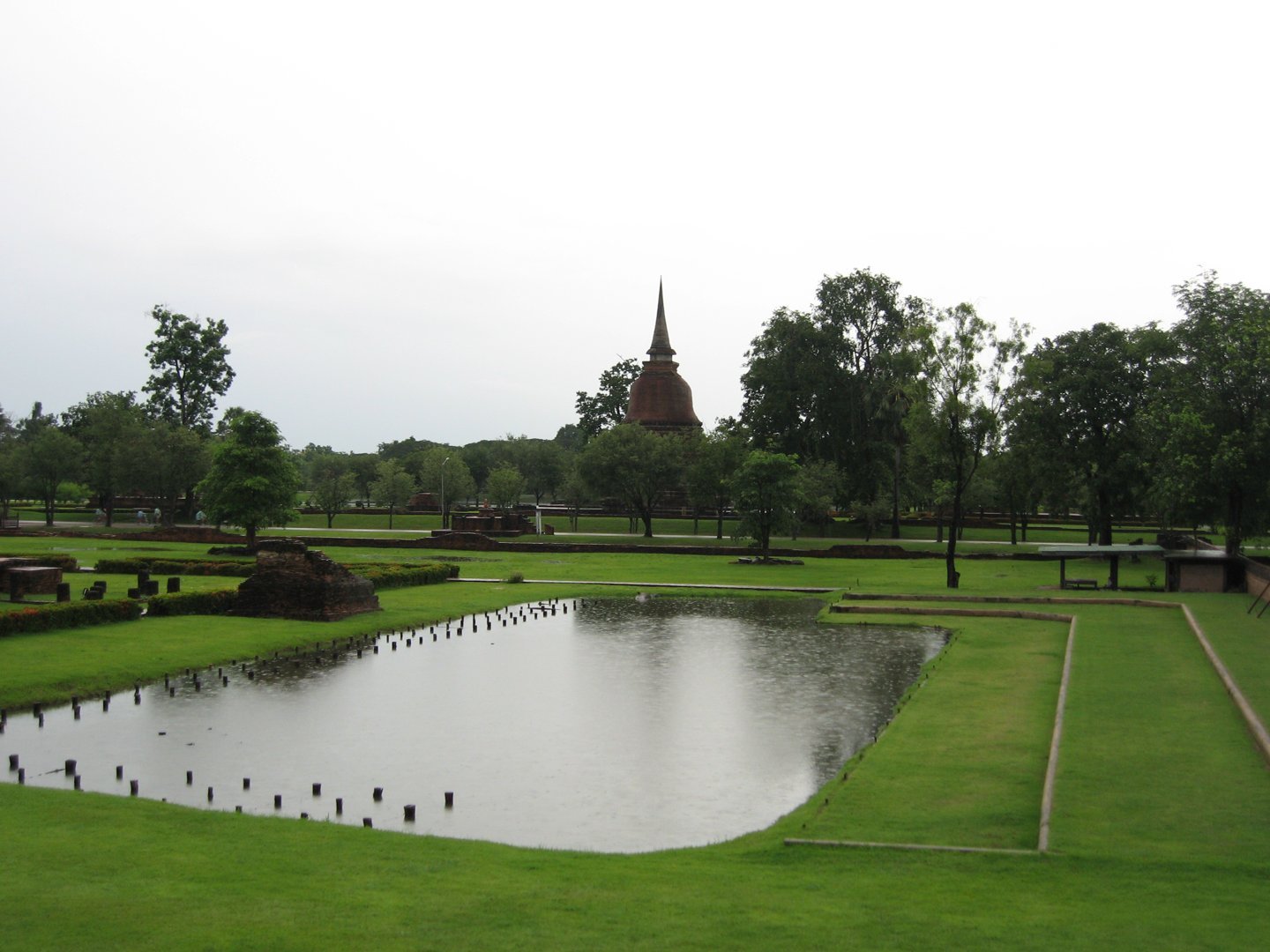

Add one outer area, rather than all of them
The northern area includes Wat Si Chum and Wat Phra Phai Luang; the western area is associated with the forest-monastery landscape. Treat these as separate extensions, not as buildings hidden immediately behind the main temple. The department organizes its monument information into inside- and outside-the-walls groups. That distinction is practical as well as historical: it affects your route, ticket questions and how much riding you are committing to.
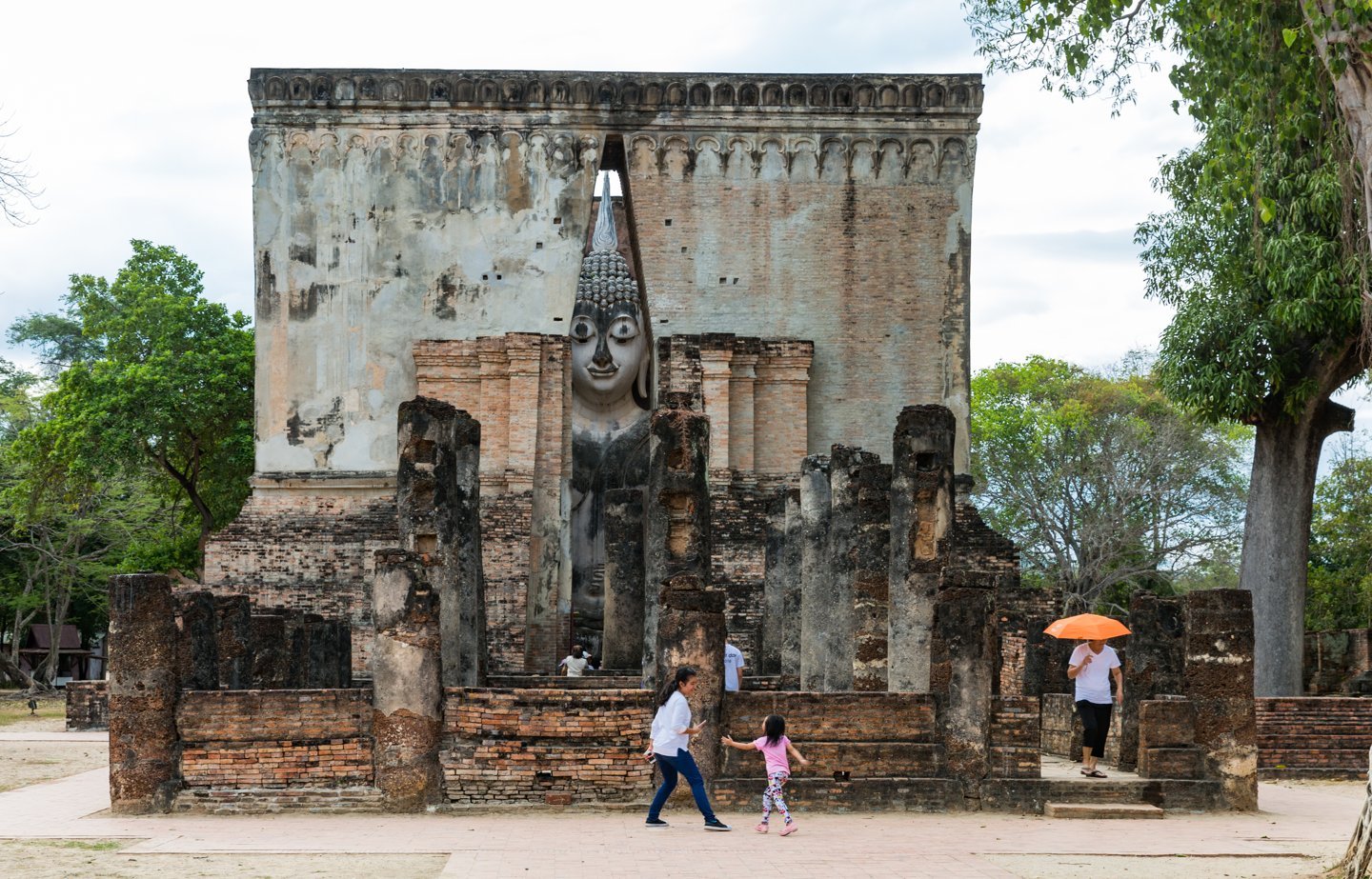
If your main interest is the large Buddha image at Wat Si Chum, make the northern extension your priority. If you want to understand how the old city related to the hills and monasteries beyond it, investigate the western circuit instead. Do not add a hilltop stop simply because it looks close on a phone screen. Ask about the approach and steps first, especially if a member of your party has limited mobility.

Choose a bicycle for the right part of the day
A bicycle can make the central monuments easier to combine, but the useful question is where you are permitted to ride and park it. Before paying for a rental, confirm the return time, whether locks are supplied and the boundaries you intend to cross. Check brakes and saddle height while you are still beside the rental shop. Leave the bicycle at the designated point when a monument requires exploration on foot.
For a mixed group, do not assume that every rider wants the same outer circuit. Agree on a meeting point before splitting up. A driver or prearranged vehicle may suit someone who wants to visit selected monuments without cycling between ticket areas. Ask for a route quote that names the actual stops and the return destination; “Sukhothai tour” can be too vague to compare transport offers.
Tickets, hours and what still needs checking
The park has different admission areas, and published information does not support treating all of Sukhothai as one universally valid ticket. Current-looking tourism listings and older department service information show different foreign-visitor prices. Check the displayed tariff for your nationality and chosen zones before buying; this guide does not present the older 100-baht figure as a verified current all-park price. Vehicle admission and bicycle rental are separate questions.
Opening information is also zone-specific. Do not plan a northern or western monument around the late closing time sometimes advertised for the central area. Saturday lighting and festival access require their own date check. For a reliable ordinary visit, build the outer circuit into daylight and confirm that day’s last admission with the park. No advance-reservation requirement, current rental price or guaranteed night-lighting programme has been established here.
Where to stay and how much to fit in
For a ruins-focused visit, compare accommodation in Mueang Kao with accommodation in modern Sukhothai town. The park is in the old-town area; the department places it approximately 12 kilometres west of the provincial town. A hotel described simply as “Sukhothai” may therefore involve a transfer before sightseeing. Check its actual address and how you will get back after returning a rental bicycle.
Our recommended first-day format is a central-area morning, a proper break, then one selected outer area if transport and energy allow. Those are planning blocks, not measured visit durations. Reserve Si Satchanalai for its own outing rather than trying to append another historic town after every Sukhothai zone. The value of the paired visit is comparison; rushing through both can remove exactly the detail that makes them different.
Read the remains without mistaking restoration for certainty
UNESCO groups Sukhothai with Si Satchanalai and Kamphaeng Phet in one World Heritage property. Their shared history helps explain a regional itinerary, but it does not mean they are one park with a single local entrance. On site, distinguish a surviving structure, a restored element and a historical interpretation in the signage. Respect barriers around fragile fabric and do not use a low platform or Buddha-image base as a place to pose or rest.
Sources & visit notes
- https://qrcode.finearts.go.th/index.php/th/historicalpark/sukhothai
- https://qrcode.finearts.go.th/index.php/th/historicalpark/sukhothai/sukhothai02/sukhothai-02-001/item/241-sukhothai03-001
- https://qrcode.finearts.go.th/index.php/th/historicalpark/sukhothai/sukhothai02/sukhothai-02-001/item/243-sukhothai03-003
- https://whc.unesco.org/en/list/574/